January 23rd, 2012 — Domestic Goddess, Etiquette, Tips
September 26th, 2011 — Etiquette, The Husband

August 5th, 2011 — Advice, Domestic Goddess, Etiquette, Tips

A lady always shows respect and consideration for others while placing a premium on honesty and graciousness. A lady also knows how her individual choices may affect others and how easy it is to choose words and actions more wisely. If you missed out on cotillion as a child, I think it best to invest in an etiquette book. ‘Emily Post’s Book of Etiquette’ is great to look up and source any question you might have and a perfect addition to any Lady’s Library. In the meantime here are my top 10 tips for being a lady in modern day society. - Taryn Cox for THE WIFE.
1. Follow Through – Nobody likes a flaky person. Regardless of how busy your life has become with commitments to your Husband and Children, you should never agree to take on more than you can handle i.e.… rsvp-ing to events, lunches with friends or other engagements. When receiving an invitation, contemplate if you’ll be exhausted from a busy day and politely decline. Many people re-arrange their schedules and look forward to plans and get upset with last minute cancellations. If a cancellation is necessary, be sincere in your apology and reschedule as soon as possible.
2. Phone Etiquette – Calls should only be placed between the hours of 9:00am – 10:00pm. Try to make a habit of returning calls within 24 hours of getting the message. When taking calls on your cell phone do consider other around you, keep conversations short and never discuss private matters in public. Your cell phone should remain in your purse and never be taken out during a meal. If need be excuse yourself from the table to check in with babysitters or any other emergencies. When in theatres or performances turn your phone to silent or off and avoid texting. Texting is extremely rude when in the presence of others.
3. Dressing Like a Lady – A lady always leaves something to the imagination, which is why one should choose to show a little leg or instead decide to accentuate your décolletage. When sitting down always cross your legs or ankles to avoid nearby peeping toms; it’s also important to practice getting in and out of cars without flashing the valet. (How to get out of a car without showing your knickers) Take the time to learn which dress codes are appropriate for certain occasions, for example if your invitation calls for “Cocktail Attire”, “Black Tie” or “White Tie,” would you know what is appropriate to wear? (Dress Code Guide)
4. It’s The Little Things – When a guest enters your home, do you offer them a glass of water or beverage of their choice? When arranging for a dinner party, do you remember if one of your dinner guests has a gluten allergy? When selecting a gift, is it something your friend mentioned they wanted? Just as a gentlemen would offer his coat if you were showing signs of being cold is how you should pay attention to small details. It’s a great way to show the people around you how much you care and are listening. Go the distance to make the people in your life feel incredibly special.
5. Always The Gracious Guest – Whether you have been invited over to a someone’s home for a dinner party, movie screening or cocktails, Never show up without a hostess gift. The gesture can be as small as a bottle of wine or dessert to as grand as having a flower arrangement delivered.
July 15th, 2011 — Article, Books, Cleaning, Cooking, Domestic Goddess, Etiquette, Health, Sex, Stationary, Things I Love, Tips

A few weeks ago, Mina, from the website MiniPiccolini asked me to share with her readers my top 10 favorite things for wives. Below are my favorite things every wife should have in her life.
1. William Sonoma - A wondrous playground for any wife who loves to cook in her kitchen. This charming store provides tools to make preparation easier, cooking classes for those who want to learn, and inspiration around every corner for those looking for creativity. www.williamsonoma.com
2. Mrs. Meyers – Every wife should have an eco friendly conscious when shopping for her household. Enter Mrs. Meyers… A collection of household products with essential oils from flowers and herbs that pack a real punch against daily dirt and grim. From dish soap to laundry detergent to window cleaners Mrs. Meyers brings a powerful clean and a garden fresh scent to your home. All their products are earth friendly, bio degradable, non toxic and never tested on animals. www.mrsmeyers.com
3. Emily Post Etiquette Book - Every wife should always carry herself like a true lady. Emily Post’s discourses on etiquette is said to be one of the most useful reference books published, next to a dictionary, a thesaurus and a world atlas. The new edition has discussions on perennially necessary topics, such as where to place a soup spoon when setting a formal table and whether one may wear white after Labor Day (the answer is yes). This integration of new material with old, showing respect and consideration for others while placing a premium on honesty, graciousness and deference. It also serves as a reminder of how individual choices may affect others and how easy it is to choose—words, wardrobes, gifts and actions—more wisely. $27.00 on Amazon.Com
4. Stationer - Every wife can benefit from a very creative and talented stationer. While I take my services to Jonathan Wright and Sugar Paper in Los Angeles, They are always there to help with last minute gifts and an abundance of greeting cards for every occasion. Your stationer can also aid you in the designing all of life’s celebrations from wedding invitations to birth announcements to personal stationary for thank you notes. Jonathan Wright 7404 Beverly Blvd, Los Angeles, California 90036 323 931 1710; Sugar Paper 253 26th Street, Brentwood, California 310 451 7870
5. La Perla – Just like the age old saying “A lamb in the kitchen and a tiger in the bedroom.” What better way to inspire a healthy and consistent sex life with your husband than with luxurious lingerie from La Perla. Every man can appreciate his wife coming to bed in a flirtatious silk night gown or something else a little more provocative. www.laperla.com
November 8th, 2010 — Books, Etiquette

A Lady at the Table will give any woman the knowledge she needs to maneuver any dining situation – from a casual meal of fried chicken at her mom’s house to a seven-course dinner at the finest restaurant in the world. It includes. . .
In a society where more and more people eat with plastic forks and spoons at fast food restaurants, it is still important that a lady know proper dining etiquette. Showing she has little working knowledge of table manners at a lunch meeting or on a job interview over dinner may have an important impact on a woman’s life.
Like all the books in the GentleManners series, A Lady at the Table is easy to use, non-threatening, and an entertaining read. In addition to containing similar information as A Gentleman at the Table, A Lady at the Table deals with topics that apply uniquely to women such as how to respond when men rise as you leave or approach the table, how to react when a chair is pulled out for you and when it isn’t, what to do when a man orders for you, and how to pay the check graciously when you are hosting a man.
Brooks Brothers also published ” How to Raise a Lady” and “As a Lady would Say.” All books are available for purchase Here.
July 6th, 2010 — Etiquette

Arrives slightly late and leaves on time.
A good guest brings energy, charm and a small present.
A dinner guest engages the person on her right and left.
A party guest mingles and meets everyone.
A houseguest is self sufficent not needing constant entertainment.
All good guests write thank you notes.
Very good guest also calls the next day. - Tiffany & Co.
April 30th, 2010 — Books, Etiquette

Drew Barrymore did it. Angelina Jolie did it. Britney Spears and Courtney Love and Whitney Houston did it. Well, those last three seem to be going back and forth between doing it and not doing it—but my point is that it’s completely possible to go from being a train wreck to being a good girl.
Look at the cases of those first two: Barrymore and Jolie. These two fine young beauties came back from a world of vices (Barrymore had a substance abuse problem and was in rehab before she was a teenager; Jolie’s adolescent tales were sordid, involving vials of blood around her neck and making out with her brother), and transformed themselves into caring, nurturing, smart women who are now world-famous actresses and, perhaps more importantly, great role models. Joining them is a whole roster of successful young women who rehabilitated themselves, from First Lady Betty Ford to actress Eva Mendes, to former reality show devil Nicole Richie.
Here’s why I bring this up: Even if you’re a train wreck, even if as you’re reading this book you’re drunk at a store and thinking about stealing it so you can trade it for a cigarette in the parking lot, there’s still hope for you. Even if you drink too much or pole dance to pay for your cell phone bill, you don’t have to be destined to an emotionally painful, liver-damaging, yellow-toothed, overly tattooed existence. Everyone has had a vice. Without fail, everyone still has one. (The person who tells you he or she doesn’t have any vices is lying—in fact, dishonesty is a vice in and of itself.)
Abraham Lincoln said, “A man without vices is a man without virtues.” So don’t lose sleep over your past. After all, part of youth is growing up and learning from your mistakes. Though your mistakes shouldn’t be so damaging they’re permanent: Don’t do something so toxic as a young woman that when you’re older you have a seizure every time you hear a bell ring; don’t pump your body with so many chemicals that when you have babies later in life they come out with three heads and twelve fingers.
But don’t beat yourself up, either. Even if you are a mess, even if you have become the type of girl no one respects, even if you are a tramp—it’s never too late to turn yourself around and become a lady. There is such a thing as second chances. (And third and fourth, for that matter.)
Here’s the thing: The perfect childhood doesn’t exist. Temptation is as old as time; or at least, the history of temptation extends as far back as the moment Eve gave Adam that serpent’s apple. But what sets the lady apart from the tramp is the ability to acknowledge she needs to clean up her act—and then, of course, the fact that she actually does clean up her act. Living a better life is an important decision, and one you have to make for yourself (no one else can make this decision for you, and it’s crucial to remember that you can’t make the decision for someone else, either).
Some of my best friends here in New York have pasts I have a hard time reconciling with the people I’m close to now. But I wouldn’t change them— or their pasts—for anything in the world. Their experiences are what made them the people they are today.
And perhaps more importantly, their experiences have provided me with some of the most amusing stories I’ve ever heard. - Whitney Vargas for Elle.Com

March 30th, 2010 — Etiquette, The Husband

There are few things that get under my skin more than witnessing a man walking with a woman on the sidewalk and the man not knowing or caring where he belongs. A man, or should I say, a gentle man, always walks on the street or curb side of the sidewalk in America (the Euro tradition states that a man walks on a woman’s left, which can be curb side or building side.) I wonder that some men are confused because they have read or heard the opposing opinion that a gentleman walks on the building side. This alternate opinion is based on the notion that in the case that a flower pot or soup can should fall from a ledge or an open window and plunk his lady friend on the head, the gentleman would be there to catch said pot or at least absorb the brunt of the collision with his own thicker skull. Then the argument for the curbside is that a woman is protected from a wet or muddy splash caused by a passing car. As for for the transgressions against this rule, I suspect the violators don’t know any better and saunter on in oblivious bliss.
Let us make this clear once and for all. A gentleman walks on the curb side of the sidewalk when walking with a woman. Basta. Of course, SP understands that this can be a bit awkward when walking in a city such as New York, Boston, Charleston or San Francisco when a couple may encounter many turns and street crossings in a relatively short jaunt. In fact, I once had a lady friend say to me, “I know you are well-mannered and your intentions are gallant, but you are annoying the hell out me with all this switching from side to side.” In this case I acknowledged (to myself) my mistake for making my action so ostentatious and vowed (to myself) to make my transitions smoother in the future. But the truth is, I can not enjoy the walk if I am not on the curb. It’s so ingrained that it’s damn near obsessive. Or is it compulsive? Whatever it is, I am content in my place and confident the majority of women appreciate the gesture. - Social Primer
February 5th, 2010 — Etiquette, The Husband
Well, another perfectly good evening was close to ruination. The cause? Inconsideration and a total lack of decorum by a few cretins masquerading as gentlemen. There is an appropriate quote from Fitzgerald in Tender is the Night, I believe, lamenting the lack of decorum in men but the passage escapes me so I’ll take this time to paraphrase (crudely). There are many things a man can and should do when out and about in public: be polite, well-dressed, groomed, always courteous and considerate to a fault. Then there are the things a man should never be seen doing in public. And these occurrences are prevalent, I tell you. I am chalking this breach of character up to pure ignorance instead of puerile arrogance. In the company of others a man should not chew gum, adjust his business or blow his nose (allergies are a different story, but try to make it the men’s room). A man should not put his hands in his mouth and never should he pick at his teeth after dinner, toothpick or not. In fact, a man should not use a toothpick in public. A man should not touch his face, fiddle with his hair, or put fingers in his nose or his ears. God forbid he should take out a brush or a comb! When in public, a man should not gaze longingly into the mirror at his own reflection. If this seems strict, it is. Men, let’s excuse ourselves to the men’s room. There in the privacy of a closed door to the general public feel free to perform your rituals, but never, ever in public. It just makes senses doesn’t it? Who wants to see these things? While we’re at it, let’s remind ourselves not to talk so loud in public. No matter how hilarious and clever we think we are, nobody who does not know you honestly wants to hear your story. Don’t guffaw and hee haw so that you draw attention to yourself or to those in your party. Respect the privacy of others. Be attentive, not disruptive. These reminders don’t seem so harsh, do they? The world is getting more crowded, not less. Let’s make it pleasant, shall we? - Social Primer www.SocialPrimer.Com
December 15th, 2009 — Domestic Goddess, Etiquette, Stationary
September 6th, 2009 — Etiquette

First of all a yacht is just a fancy word for any boat bigger than a skiff. Defined as a vessel used for private cruising, racing, or other non-commercial purposes, sailboats, motor boats, pontoon boats, and yes, Aristotle Onassis’s Christina are all considered yachts. Do not let the word — or the invitation — intimidate you. There is nothing greater than a day spent on the water on board a beautiful boat sailing the bounding main. Tasty drinks, beautiful company, the spray of the sea and a breathtaking sunset combine for one of life’s most inspiring moments. Parties on board a boat do not necessarily take place on the open sea. The boat can be tied up in the slip, on the mooring or at anchor. How you behave and the time you will have depends on the type of event your host has planned. So before you shove off, let’s go over a few things first. Drinks parties on board a boat follow the same rules as illustrated here with a few additions for the concerns of safety and respect for nautical tradition. In sailing, when you say someone is being un-Corinthian, you’re saying the person does not conduct themselves in a gentlemanly manner. Herewith your Corinthian guide to a well-spent and safe day on the water.
First, a few handy nautical terms:
Lines – the seaman’s word for rope.
Slip – A slip is where a boat is tied up beside the dock at the marina. This is the easiest to board as you walk right on from the same level dock.
Mooring – These are the buoys out in the mooring field where larger vessels tie up if they are not in a slip or on anchor, usually about a hundred yards out in the water away from the marina.
Dingy (or Skiff) – this is the captain’s little boat that shuttles you back and forth to the bigger boat out on the mooring.
Launch (or water taxi) – this is a bigger skiff that is usually run by the marina to take you out the boat on the mooring. If at a public marina, you should tip the driver a dollar to two for his service. FYI: You would never tip staff at any private club. This is taken care of by the member in his club dues.
Yacht Party Rules
Rule One: No Shoes on Deck. Do not wear hard-sole shoes on a boat. The deck of a boat is easily scuffed and no captain wants you marking up his shiny deck. To wear hard-sole shoes onto a boat is highly insulting to the captain. And tell your lady friend to leave her high heels on shore. White Rubber Sole Shoes are the only appropriate shoes to wear on board a boat. No Vibram black-sole work boots or any boots with a black sole as they can leave black scuff marks. Get thee to the Sperry store.
Rule Two: Permission to Come Aboard, Captain. Never climb aboard a boat until you are given permission by the captain or crew. This is not only respectful and traditional but gives the captain a chance to advise passengers on the proper boarding of the vessel. This rule is as old as the sea and still holds true today.
Rule Three: Bundle Up. It matters not if you are cruising the Gulf of Mexico, sailing out to Catalina or crossing Cape Cod Bay in the middle of the summer. Weather is a tricky friend on the water and it always gets chilly after dark. Bring a windbreaker and a sweater. No captain wants to hear you whine about how cold it is. Most boats have extra gear on board for just such occasions, but do you really want to wear a stinky mildew fish jacket that’s been stored down below for ten years?
Rule Four: Respect the Sea. Boats are mighty amazing vessels to spend an afternoon upon. Whether you are in the slip, on the mooring (or anchor) or cruising the open sea, boats are sophisticated creations sitting on top of bouncing water where at any moment things can go terribly wrong. Stay alert and stay out of the way. Respect the Captain, the crew and the vessel as if your life depended on it. Because it does.
Rule Five: Don’t Dangle. Do not wear anything loose or dangling, especially on a sailboat, that can get caught in the rigging. Scarves, jewelry, even a sweater around the shoulders can snag easily on a line or rigging. That goes for long flowing hair as well. And again, tell your lady friend this rule. Nothing can ruin a sunset cruise faster than someone being yanked overboard, getting hanged or decapitated in the rigging.
Rule Six: Be Ready to Crew. One of the joys of sailing is participating in the labor of making the vessel move. If the captain asks you if you would like to crew you should jump at the chance. Be honest. Tell him you’ve never done this before, but are eager to learn. Any captain worth his salt will relish the chance to order a novice around. Just pay attention to his orders and watch what the mate beside you is doing. If you choose to crew – and by all means don’t let the chance slip by — you must follow the captain’s directions in military style. The captain’s word is law on the sea.
Rule Seven: Don’t Jump Ship. Yes, it’s been a long afternoon at sea. You are windblown, sun burnt and probably a little drunk. You have had a great time but now that the boat in on the mooring you just want to jump in the launch and head back to shore. There are a lot of things to do on a boat, especially on a sailboat after a cruise. If there is no crew, you, my man, are the crew. Help to roll up and put the cover on the sail. Straighten out the lines and clean up the cups strewn about the deck. Many a time a generous captain has been left stranded on his boat while the guests he just spent an afternoon entertaining jump into the launch and head back to shore. Do not let this be you. You want to be invited back again, remember?
Basic Sailing Terms and Maneuvers:
The crew’s active participation is integral to the art of sailing. This applies to all passengers on a sailboat as well. When a sailboat changes its direction, the wind will shift the sails to new positions causing the center of gravity to shift to a new balancing point. This can be alarming to some passengers. An organized and controlled movement by the passengers and crew will make a much more pleasant and safe journey at sea possible.
Tacking. When tacking upwind, the captain will call out the following command, “Ready About” where upon all souls on board answer “Ready”. The captain will not start his maneuver to change direction until he has heard a reply from all on board.
Helms A Lee. After the response “Ready” the captain will command “Helms A Lee” telling the helmsmen (that’s the crew member behind the wheel) to turn the boat toward the direction of the wind by pushing the tiller to leeward slowly until the boat begins to head into the wind.
Windward is the direction from which the wind is blowing at the time in question. The side of a ship, which is towards the windward, is the weather side. If the vessel is heeling under the pressure of the wind this will be the side higher in the air.
Heeling is when a boat leans over to one side and is caused by wind or waves.
Leeward is the direction downwind from the point of reference. The side of the boat towards the leeward is its lee side. If the vessel is heeling under the pressure of the wind this will be the side lower to the water.
Tacking is the other way to change the side of the boat that faces the wind, turning the bow of the boat through the direction of the wind. This operation is also known as Coming About.
Jibing - A jibe or gybe is a maneuver where a sailboat turns her stern through the wind, such that the wind direction changes from one side of the boat to the other. In this maneuver the mainsail will cross the center of the boat while the jib is pulled to the other side of the boat. To the novice this is a somewhat violent maneuver. The most dangerous maneuver is jibing down wind. In this case the captain will instruct each passenger where he or she should be seated. The main sail (meaning the boom) must cross over the cockpit swinging directly overhead. The captain will command “Prepare to Jib”. Instructions regarding the maneuver will follow. Then the captain will command “Ready to Jib”. The crew and passengers respond, “Ready”. Then the captain calls out “Jib Ho” indicating the maneuver is underway. On a sailboat, it is critical that all on board work together. This is how it’s been done for centuries. Respond on every command. Nothing is more irritating to the captain and your fellow crew than to hear the captain call the command repeatedly waiting for you to respond. This is your duty should you choose to accept it. And you should choose to accept it. This is one of life’s greatest thrills.
Recommendations: Seasickness can not only ruin a boating excursion for everyone on board, but it is one of the most miserable experiences one can endure, especially if your cruise has taken you far out to sea and a quick return to shore is not possible. Don’t let this condition – or fear of this condition – stop you. There is seasickness patch you can buy by prescription at any drug store that you put on the back of your neck the night before a sail and you will be fine. If you are a novice on the water, stay above deck. Going below into the cabin is a sure way to get sick for those who are new to boating. And if you aren’t used to drinking on the rolling sea, refrain from drinking alcohol. Wait until the boat is back on the mooring or in the slip before a drink. - SocialPrimer
www.SocialPrimer.Com
August 28th, 2009 — Domestic Goddess, Etiquette

A good wife writes thoughtful handwritten Thank you notes for gifts recieved and other kind acts of generosity. Orginally thank you notes for hospitality or attending dinner in a friends home used to be reffered to as ‘Bread and Butter’ Letters. The writer is thanking his or her hosts for their hospitality (and food), but the letter is also a basic social formality, not likely to contain any exciting content. A “bread and butter” note may not be eagerly awaited, but it’s the sort of thing expected and probably noticed most in its absence.
Occasions when a Thank You Card Should be sent.
August 28th, 2009 — Etiquette
August 28th, 2009 — Etiquette
*Do remember that a gift should be acknowledged with the same courtesy and generous spirit in which it was given.
June 24th, 2009 — Etiquette, Travel
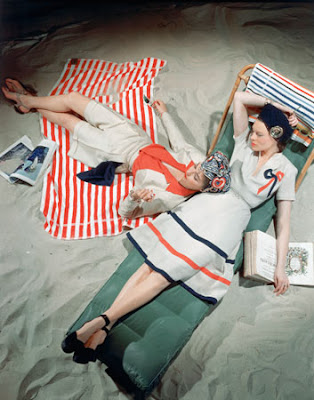
House Guest Rules:
Rule One:
Rule Two:
Rule Three:
Rule Four:
Rule Five:
Rule Six:
The point here should be clear. You should completely alter your schedule, behavior and expectations to that of your host. If you present yourself as entertaining, pleasant and trouble-free you should have a grand old time and head back to your life well-rested while running through the memory of a weekend well spent. Nobody ever said being a house guest was easy, in fact it can be downright draining sometimes, which is why you should refrain from making a habit of it.
Tips for Service
When you are staying with friends who have permanent, live-in household staff in the city, in the country or at the beach it is appropriate to tip these workers for services performed. These staffers have their normal duties of attending to the household plus the added burden of cleaning up after you. Especially if they make your bed, provide fresh towels and present breakfast and lunch every day. At the end of a trip, slide $10 for every day you were there into an envelope with a little note, “Thank you Matilda.” If there is multiple staff you should leave multiple tips (called “vails” in the Middle Ages). Present the tip in separate envelopes to the cook and to the housekeepers. One side note: make this action discreet. SP once made the mistake of offending a hostess when she discovered the tip to her staff. The misunderstanding in her mind was that her staff is taken care of by her and my tip was offensive. To set the record straight, this hostess was misguided. One does indeed tip household staff. SP stumbled by letting the hostess discover the tip in the first place. Hand the envelope directly to the staff or place it under an object that is impossible to miss.
House Guest DO
Offer to help and anticipate your host’s needs
Keep your room clean and the bed made
Offer to replace or repair anything you break, lose or mishandle
Strip the bed when you leave, fold and leave sheets on top of the bedspread
House Guest Don’t
Act like a guest
Don’t invite friends over or be always on the road visiting others than your hosts
SP recommends: Stylish luggage at any price can be seen first at www.classicluggage.com, www.tumi.com, or www.bottegaveneta.com. These are guides to style and shapes. If you are on a budget, select the style you prefer, jot down the style number and then see if you can find the valise on eBay or craigslist. Or just go to the standby, www.llbean.com and be done with it.
SP also recommends: Hostess gifts can be simple. If you know the host well it is easier to buy something that fits her or his style. If you don’t, here are a few gifts that can’t go wrong: a jar of fancy jam, a leather guest book, monogrammed soaps with your host’s initial, a coffee table book, gardening or cookbook, an ash tray, wine key or bottle opener. Monogrammed paper guest towels or a note pad are always nice. Or an elegant deck of monogrammed playing cards or drink coasters. - Social Primer
May 14th, 2009 — Etiquette
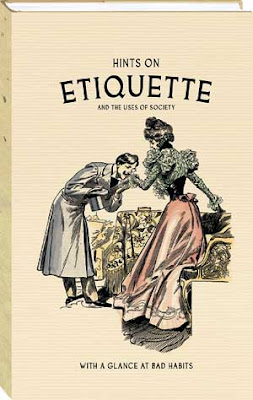
How many times do you find yourself in this social (or business) situation? You are standing in a covey of people immersed in a rolling conversation when all at once you realize that you don’t know the names of some of the people you are talking to. There is a queasy feeling of awkwardness rising in your chest and you don’t know how to correct the situation so you ride the roll through to the inevitable conclusion, parting ways without ever knowing who was who. There is an old saying — referring to a gathering in a private house — that says “The roof constitutes an introduction,” meaning you shouldn’t introduce people in a private home. This is predicated on the assumption that the host has done his job and anyone under his roof should already be introduced to one another. This old rule was accepted in the days before the transportation revolution and familial displacement sent us all scurrying and gathering into far flung places. When your mothers were old acquaintances and all families and friends were well-known in a small community, this rule held true, and so it goes today. But we are a long way from cozy community living. We are citizens or the world. Let us always introduce ourselves.
In today’s hurly burly society one must pay extra attention to the small civilities. In the course of a conversation, it is never too late to say your name. But let’s be clear. You should say your name at the outset and expect the same courtesy of those you are meeting. It is always annoying — not to mention ill-mannered — to introduce one person to another without saying both or more of the parties’ names. And that should be first and last names, mind you. This lapse is yet another casualty of the modern age when we neglect to say someone’s first and last name, or worse mumble incoherently over the din in a crowded room. I know what you are thinking, but what if I don’t know their last name when I make the introduction? Let me be clear. It is not rude to ask someone their last name. Get this out of the way right at the beginning. If you’ve been introduced before and you’ve forgotten this is not a crime to ask again. Just don’t make a habit of it. To habitually forget someone’s name, first or last, is the height of incivility, the depth of laziness and in the end, just plain rude.
On the other hand, you should always remind people of your own name and even volunteer a little history of when you met. “I am Robert Hightower. We met at the Wilson’s Christmas Party.” This will assuage any awkwardness brewing inside the person you are greeting. And this person, in kind, should respond, “Of course I remember, Robert. It is so good to see you again.” No matter if this is true or not. The point of good manners is to make people feel at ease. Generosity is always the first rule of the day.
In greeting and introductions, here are some golden rules to live by:
Always say “How do you do?” or “It’s great to see you.” Never say “It’s nice to meet you,” unless you are absolutely positive you have never met before. In fact, you should simply remove this phrase from your social repertoire altogether and always say “It’s nice to see you.”
Never say “Do you remember me?” This puts the other person in the awkward position of saying “No.”
Never announce a person’s vocation in a social introduction. In business, the opposite is true. If the gathering is business and social, then by all means include the vocation.
Finally, never put someone on pause that has come up to you to say hello. If you are so engrossed in a story with Helen Highwater that you feel compelled to ask Jasper Jones to hold while you finish, you should remove Mrs. Highwater to a private room — or go outside — so as not to be interrupted. Or better yet, call her the next day. Put yourself on pause, never Mr. Jones. This incident is far too common and exceedingly rude. On the other hand, Jasper Jones should not interrupt someone who is obviously engrossed in deep, gesticulating conversation. Although gesticulating conversation has no place at a drinks party, some people do engage in such. SP says keep it light and always be open to widening your circle. Isn’t this why you attend these things in the first place?
www.SocialPrimer.Com
March 1st, 2009 — Etiquette
January 3rd, 2009 — Etiquette, Wedding
November 6th, 2008 — Etiquette, Stationary
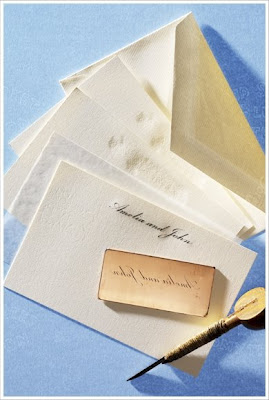
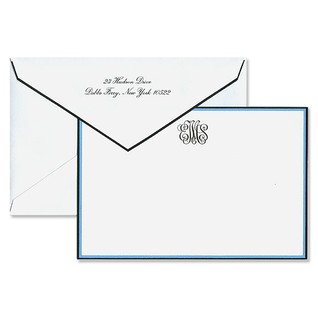
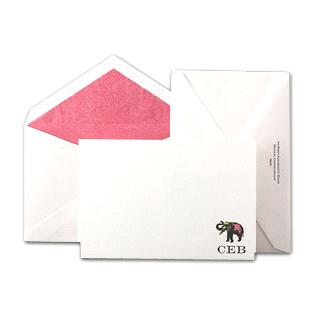
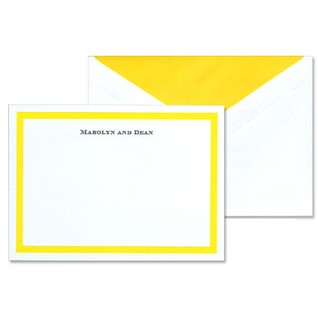
Buy thank-you cards early, so you have them on hand. When you open presents, immediately record who gave you what, either in a log or right on the gift cards. Ideally, you should acknowledge every present immediately; writing a note the day you receive it is best, but sending it within two weeks is also acceptable. If you fall behind, just make every effort to send a thank you as soon as you can – but no later than three months after the event.
You can take your invitations to the post office and request that they be hand-canceled. Machines print bar codes on the envelopes, but hand-canceling — just marking each stamp — keeps invitations neat and prevents damage that machines can cause. - Martha Stewart


October 24th, 2008 — Etiquette

Description-
“Making a good first impression, tipping for a haircut, dispensing with a large handful of cherry pits, and determining the so called pedestrian passing lane on a crowded sidewalk are just some of the many etiquette conundrums we all face. As liberated as we’ve become in our dresses and in our lifestyles, good manners are still essential.
Whether you’re in Boston or in phoenix, and whether you’re a record producer or a dog groomer, the same quandaries can occur: who goes through a revolving door first, a man or a women? When is it polite to correct someones mispronunciation of your name? and what if you can’t see over the head of the person who has just sat in front of the you at the movies.” - Kate Spade


Photos, Expert, and Description From Kate Spades “Manners”
Available at Kate Spade or Amazon.com, 20.00
October 24th, 2008 — Etiquette, Kids

Emily’s Everyday Manners
By Peggy Post and Cindy Post Senning, Ed. D.
A new book for children aged 4-7 illustrated by Steve Björkman
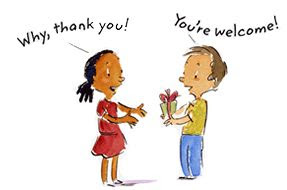
Remember learning the Magic Words? They were simple phrases your parents insisted upon at home, at school and while visiting friends and family. Please, Thank You, and You’re Welcome made people smile, impressed your aunts and uncles, and, though you didn’t realize it at the time, also made a good impression.
Those Magic Words, and other etiquette basics, come to life in Emily’s Everyday Manners (HarperCollins Children’s Books; August 2006; $16.99), written by Peggy Post and Cindy Post Senning and illustrated by Steve Björkman. Kids 4-7 can read along and watch as young Emily and her best friend Ethan ride the school bus, romp on the playground, visit friends, and eat at restaurants—all while having fun and using their best manners.
From the most trusted name in etiquette this charming picture book explains why everyone should know and use the social graces. With clever text, cool illustrations, and a large measure of humor, Peggy Post, Cindy Post Senning and Steve Björkman make clear the importance of developing good character and encouraging children to genuinely care for and appreciate others.
- Artical and Game from EmilyPost.com
Magic Words Game
Please
Thank You
You’re Welcome
Excuse Me
Nice to Meet You
May I?
I’m Sorry
Abracadabra
Situations:
You meet the President of the US.
You would like a cookie.
You want to turn spinach into ice cream.
Your mom thanks you for setting the table.
You bump into your friend.
You accidentally break a plate.
You would like to borrow a toy.
Your friend shares his apple with you.
answers: 1-b; 2-h; 3-d; 4-e; 5-a; 6-g; 7-f; 8-c
October 24th, 2008 — Etiquette, Kids

“Manners Reflect the Wisdom of our time” - Diane
With Cotillion Season Commencing this fall, I think we can all agree that we’d like our children to be skilled in the social graces, whether they’re enjoying supper with the ambassador to Switzerland on your next family ski trip to Gstaad, or at a birthday party chezChuck E. Cheese.
For those parents who are devoted to raising their children to be the very best dinner guests, museum-goers, and cotillion invitees that they can possibly be, I suggest you check out Beverly Hills Manners. The company offers a variety of children’s programs from a beginner’s fine dining course (“not that fork!”) to a week-long etiquette camp where I’m all but certain there’s no latrine duty. There’s even private tutorial for those who’d prefer to keep the learning at home on the estate.
Your little ones will learn much more than simply not to put their elbows on the table-like how to write thank you notes and why the clothes that Paris and Britney wear aren’t suitable for the third grade. Such training is infinitely more valuable than yet another pedestrian Mommy and Me class, wouldn’t you agree?
Naturally, these courses are taught only in Los Angeles, New York, and London. But since your children are no doubt headed to Oxford on scholarship, you can afford to dip into their trust funds and charter a flight.
Beverly Hills Manners
www.BeverlyHillsManners.Com
They offer locations in: Newport Beach and Beverly Hills

"THE WIFE" is for the timeless wife or elegant wife to be. Whether THE WIFE favors a career working in the corporate world or has dedicated her time and efforts as a housewife, She always maintains a happy and healthy family. THE WIFE is an astounding women and amazing mother, who proudly makes time for her husband and children. THE WIFE loves to cook, has a passion for party planning, a fondness for etiquette, adores decorating and keeping a beautiful home and of course dressing the part. THE WIFE cares about being "green" and takes the time to make her home environmentally friendly. Finally THE WIFE dedicates her spare time to charitable causes and giving back to her community. Women who might inspire THE WIFE would be: Jacqueline Kennedy, Michelle Obama, Grace Kelly, Gwyneth Paltrow, Jenna lyons and Carolina Herrera.
Grammar Warning: I am clearly aware that my grammar is sub par. Please excuse any typos or misspelt words you may come across when reading this blog. There is not need to write or notify me. Thank You Kindly.
- Miss Taryn Cox