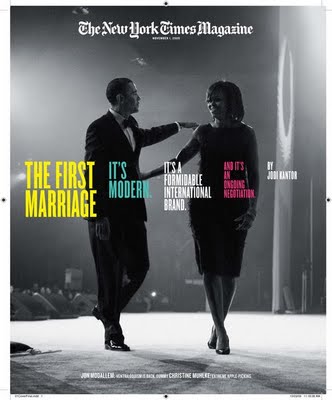
I. Another Washington dusk, another motorcade, another intimate evening played out in public view. On Oct. 3, just a day after their failed Olympics bid in Copenhagen, Barack and Michelle Obama slipped into a Georgetown restaurant for one of their now-familiar date nights: this time, to toast their 17th wedding anniversary. As with their previous outings, even the dark photographs taken by passers-by and posted on the Web looked glamorous: the president tieless, in a suit; the first lady in a backless sheath.
The Obama date-night tradition stretches back to the days when the president spent half his time in Springfield, Ill., reuniting at week’s close with his wife, who kept a regular Friday manicure and hair appointment for the occasion. But five days before he ventured out for his anniversary dinner, the president lamented what has happened to his nights out with his wife.
“I would say the one time during our stay here in the White House so far that has. . . .” He paused so long in choosing his words that Michelle Obama, sitting alongside him, prompted him. “Has what?” “Annoyed me,” the president answered. “Don’t say it!” the first lady mock-warned. “Uh-oh.”
“Was when I took Michelle to New York and people made it into a political issue,” he continued, recalling the evening last spring when they flew to New York for dinner and a show, eliciting Republican gibes for spending federal money on their own entertainment.
We were in the Oval Office, nearly 40 minutes into a conversation about the subject of their marriage. Watched over by three aides and Gilbert Stuart’s portrait of George Washington, the two sat a few feet apart in matching striped chairs that made them look more like a pair of heads of state than husband and wife. The Obamas were talking about the impact of the presidency on their relationship, and doing so in that setting — we were in the room that epitomizes official power, discussing the highly unofficial matter of dates — began to seem like a metaphor for the topic itself.
“If I weren’t president, I would be happy to catch the shuttle with my wife to take her to a Broadway show, as I had promised her during the campaign, and there would be no fuss and no muss and no photographers,” the president said. “That would please me greatly.” He went on to say: “The notion that I just couldn’t take my wife out on a date without it being a political issue was not something I was happy with.” Everything becomes political here, I offered, gesturing around the room. “Everything becomes political,” he repeated very slowly. Then he said: “What I value most about my marriage is that it is separate and apart from a lot of the silliness of Washington, and Michelle is not part of that silliness.”
Perhaps she is not. But the Obamas mix politics and romance in a way that no first couple quite have before. Almost 10 months ago, they swept into Washington with inauguration festivities that struck distinctly wedding-like notes: he strode down an aisle and took a vow, she wore a long white dress, the youthful-looking couple swayed to a love song in a ceremonial first dance and then settled into a new house. Since then, photograph after official White House photograph has shown the Obamas gazing into each other’s eyes while performing one or another official function. Here is a shot of the Obamas entering a Cinco de Mayo reception, his arm draped protectively around her back. Next, a photo of the president placing a kiss on his wife’s cheek after his address on health care to Congress. Poster-size versions of these and other photographs are displayed in rotation along the White House corridors. It’s hard to think of another workplace decorated with such looming evidence of affection between the principal players.
The centrality of the Obama marriage to the president’s political brand opens a new chapter in the debate that has run through, even helped define, their union. Since he first began running for office in 1995, Barack and Michelle Obama have never really stopped struggling over how to combine politics and marriage: how to navigate the long absences, lack of privacy, ossified gender roles and generally stultifying rules that result when public opinion comes to bear on private relationships.
Along the way, they revised some of the standards for how a politician and spouse are supposed to behave. They have spoken more frankly about marriage than most intact couples, especially those running for office, usually do. (“The bumps happen to everybody all the time, and they are continuous,” the first lady told me in a let’s-get-real voice, discussing the lowest point in her marriage.) Candidates’ wives are supposed to sit cheerfully through their husbands’ appearances. But after helping run her husband’s first State Senate campaign in 1996, Michelle Obama largely withdrew from politics for years, fully re-engaging only for the presidential campaign. As a result, she has probably logged fewer total sitting-through-my-husband’s-speech hours than most of her recent predecessors. Even the go-for-broke quality of the president’s rise can be read, in some small part, as an attempt to vault over the forces that fray political marriages. People who face too many demands — two careers, two children — often scale back somehow. The Obamas scaled up.
“This is the first time in a long time in our marriage that we’ve lived seven days a week in the same household with the same schedule, with the same set of rituals,” Michelle Obama pointed out. (Until last November they had not shared a full-time roof since 1996, two years before Maliawas born.) “That’s been more of a relief for me than I would have ever imagined.”
The couple now spend more time together than at nearly any other point since their early years together. On many days, they see Malia and Sasha off to school, exercise together and do not begin their public schedules until 9 or even 10 o’clock. They recently finished redecorating the White House residence, the first lady requesting an outdoor rocking chair for her husband to read in, the president scrutinizing colors and patterns, said Desirée Rogers, the White House social secretary. The pair recently began playing tennis. (He wins, she admitted; for now, he added.) This summer, the first lady surprised her husband for his birthday by gathering his old basketball buddies for a weekend at Camp David.
Barack and Michelle Obama are also a more fully fused political team than ever before, with no other jobs to distract them, no doubts about the worthiness of the pursuit dogging them. Theirs is by no means a co-presidency; aides say the first lady has little engagement with banking reform, nuclear disarmament or most of the other issues that dominate her husband’s days. But their goals are increasingly intertwined, with Michelle Obama speaking out on health care reform, privately mulling overSupreme Court nominees with the president and serving as his consultant on personnel and public opinion. When they lounge on the Truman Balcony or sit inside at their round dining table, she describes how she believes his initiatives are perceived outside Washington; later, say advisers, the president quotes the first lady in Oval Office meetings.
If winning the White House represents a resolution of the Obamas’ struggles, it also means a new, higher-stakes confrontation with some of the vexing issues that fed those tensions. Their marriage is more vulnerable than ever to the corrosions of politics: partisan attacks, disappointments of failed initiatives, a temptation to market what was once wholly private. Some of the methods the Obamas devised for keeping their relationship strong — speaking frankly in public, maintaining separate careers, even date nights — are no longer as easily available to them. Like every other modern presidential couple, the Obamas have watched their world contract to one building and a narrow zone beyond, and yet their partnership expand to encompass a staff and two wings of the White House. And while the presidency tends to bring couples closer, historians say, it also tends to thrust them back to more traditionbound behavior.
For all of their ease in public, the Obamas do not seem entirely comfortable with the bargain. As they talked about their marriage, they seemed both game and cautious, the president more introspective about their relationship, the first lady often playing the big sister dispensing advice to younger couples.
Then I asked how any couple can have a truly equal partnership when one member is president. Michelle Obama gave what sounded like a small, sharp “mmphf” of recognition, and the fluid teamwork of their answers momentarily came to a halt. “Well, first of all. . . .” the president started. His wife peered at him, looking curious as to how he might answer the question. “She’s got. . . .” he began, but then stopped again. “Well, let me be careful about this,” he said, pausing once more. “My staff worries a lot more about what the first lady thinks than they worry about what I think,” he finally said, to laughter around the room.
The question still unanswered, his wife stepped back in: “Clearly Barack’s career decisions are leading us. They’re not mine; that’s obvious. I’m married to the president of the United States. I don’t have another job, and it would be problematic in this role. So that — you can’t even measure that.” She did add that they are more equal in their private lives — how they run their household, how they raise their children, the overall choices they make.
Interpreting anyone’s marriage — a neighbor’s, let alone the president’s — is extremely difficult. And yet examining the first couple’s relationship — their negotiations of public and private life, of conflicts and compromises — offers hints about Barack Obama the president, not just Barack Obama the husband. Long before many Americans, Michelle Obama was seduced by his mind, his charm, his promise of social transformation; long before he held national office, she questioned whether he really could deliver on all his earnest pledges. For nearly two decades, Michelle Obama has lived with the president of the United States. Now the rest of us do, too.
II. JUST BEFORE THE Rev. Jeremiah A. Wright Jr. pronounced Barack Obama and Michelle Robinson man and wife on the evening of Oct. 3, 1992, he held their wedding rings — signifying their new, enduring bonds — before the guests at Trinity United Church of Christ. Michelle’s was traditional, but Barack’s was an intricate gold design from Indonesia, where he had lived as a boy.
Neither needed a reminder of just how fragile family — the black family, marriage, life itself — could be. Barack Obama Sr.’s relationships, not just with his wives but also with his children, were fleeting; in 1982, he died at the age of 46. Michelle’s parents had a long, stable marriage, but her maternal grandparents split without ever formally divorcing, and her paternal grandparents separated for 11 years. Before Michelle, Barack had brought only one woman to Hawaii to meet his family, according to his younger half-sister, Maya Soetoro. He in turn was Michelle’s first serious boyfriend, according to Craig Robinson, Michelle’s brother: none of the others had met her standards.
During their three-year courtship, the couple shared thrilling moments, like when Barack became the first black president of the Harvard Law Review. But there were crushing ones too. In early 1991, Fraser Robinson, Michelle’s father, came down with what seemed to be the flu. Just a few days later, he was brain-dead, and his family had to decide whether to end life support, according to Francesca Gray, his sister. Barack was in the middle of classes, with no money to speak of, but he flew to Chicago anyway. At the wedding the following year, Craig Robinson took his father’s place in walking Michelle down the aisle.
The Obamas were married just a month before the presidential election, a time of mounting excitement for Democrats in their neighborhood of Hyde Park and beyond. Bill Clinton looked as if he might take the White House back from Republicans. Barack was helping by running a voter-registration drive so successful that he won notice in Chicago newspapers and political circles. (Clinton ended up carrying Illinois, then a tossup state.) Obama’s efforts also helped make Carol Moseley Braun, a fellow Hyde Park resident, the first African-American woman in the U.S. Senate. Suddenly politics seemed full of new possibilities. Barack had talked to Michelle about running for office; she had misgivings but thought the day was not imminent.
For the moment, he was enmeshed in writing his memoir, “Dreams From My Father.” He had retreated to Bali for several weeks to work on the manuscript and was still preoccupied with it after his return. “Barack was just really involved in the book. [Michelle] and I would do lots of shopping and movies,” Yvonne Davila, still a close friend, remembered. “Barack doesn’t belong to you,” she told me she warned Michelle.
III. 1IN THE ANNALS of presidential coupledom, the Obamas more than slightly resemble the Clintons: a pair of Ivy League-trained lawyers, the self-made son of an absent father and a wife who sometimes put her husband’s ambitions ahead of her own. But unlike Bill Clinton, who turned his wife into an unlikely Arkansan, Obama planted himself on his wife’s turf. And while the Clinton marriage seems forged in shared beliefs about the promise of politics, the Obama union has been a decades-long debate about whether politics could be an effective avenue for social change. Even as a community organizer, Barack aimed to prod elected officials into action. His wife, who was more skeptical of politicians, tried to bypass them: when she took a job promoting community-organizing techniques, she focused on what neighborhoods could accomplish without their help.
In 1995, a State Senate seat was opening up, and Barack, then 34, announced his candidacy. “It allowed me to get my feet wet in politics and test out whether I could get something done,” he told The Times two years ago. Because he wasn’t from Chicago, had degrees from two elite schools and a background that others found odd, a friend said, he felt he had to begin by running for a relatively modest office.
As the Obamas sat with friends around their dining room table, eating Michelle’s chili and planning the run, she was plainly hesitant. “She was very open about not wanting to be in politics,” Davila said. Michelle had always wanted to be a mother, three years had passed since their wedding and now her husband — with his all-consuming memoir just finished — would be gone several days a week. Michelle “just wasn’t ready to share,” Carol Anne Harwell, who became the campaign manager, recalls. Besides, he was the former president of the Harvard Law Review, a writer and a teacher at a premier law school, the University of Chicago. Springfield was home to financial scandal so pervasive it was barely considered scandalous. “I married you because you’re cute and you’re smart,” Michelle later said she told her husband, “but this is the dumbest thing you could have ever asked me to do.”
She became his most energetic volunteer anyway. “She did everything,” Craig Robinson says. Every Saturday morning, she and Davila knocked on doors for petition signatures that would put Barack on the ballotAs a first-time candidate, Barack could be stiff; friends remember him talking to voters with his arms folded, looking defensive. Michelle warmed everyone up, including her husband. “She is really Bill, and he is really Hillary,” one friend recently put it. But like Hillary Clinton — and countless other political wives — Michelle sometimes took on the role of enforcer. If a volunteer promised to gather 300 petition signatures, “299 did not work because 300 was the goal,” Harwell says. “You met the wrath of Michelle.”
Harwell also noticed that the candidate’s wife was constantly trying to upgrade the campaign, eliminating anything that seemed tacky or otherwise redolent of the less-than-exalted standards of Illinois state politics. Instead of a beers-in-a-bar fund-raiser, Michelle arranged a party at the DuSable Museum of African American History with a band and a crowd of young professionals. When Harwell found an inexpensive office space with dingy walls, Michelle vetoed it. “She was like, ‘Oh, no, no, no,’ ” Harwell says. “ ‘Why would we reduce ourselves to this?’ ”
IV. ONE DAY LAST SPRING, I walked into the Hyde Park apartment the Obamas bought when they married, hoping to find clues to their old lives. Their unit, part of a complex of redbrick houses turned condominiums, had a few appealing touches — a green-tiled fireplace, a dining room with elaborate woodwork and a small porch in the back (where Michelle let her husband smoke, a friend said). But the apartment was narrow and worn, with fixtures that must have been aging even several years ago. The Hole — as Michelle called her husband’s tiny, dark office — lived up to its name. The cramped master bedroom had a closet barely big enough for one wardrobe. Where did Michelle keep her clothes? The apartment was neat, friends said, but bursting with children’s gear and toys. The dining table tilted so much that food sometimes skidded south, eliciting an embarrassed look from Barack.
He would eventually learn to make his way in the State Senate, but his initial reports home were dismayed: Republicans held control, legislation he drafted was not even heard and even some Democrats teased him about his name. “He would call me and say: ‘This person is an idiot. They get an F,’ ” Harwell says.
“He went to Springfield without fully appreciating all of the consequences,” said Judson Miner, Barack’s boss at the civil rights law firm where he’d been working for several years. Shortly after arriving, Barack called Miner to tell him that he was scaling back his legal work: he could not stay on top of it from downstate. Barack took on a heavier teaching load to compensate for the lost income. Michelle, who had given up corporate law, now earned less than $50,000 a year at her nonprofit job training young leaders, a former colleague estimates.
For Barack’s swearings-in, Michelle would travel to Springfield. Harwell remembers Barack calling up with a report from downstate: “ ‘Michelle just couldn’t believe it, she had to come down to see this mess for herself.’ ”
As she heard Barack’s tales from Springfield, Michelle learned “how good legislation vanished overnight for political reasons,” Valerie Jarrett, one of the Obamas’ closest friends, told me recently in her White House office, where she is senior adviser to the president. This, Jarrett said, left Michelle even more frustrated than her husband. “He’s more of a pragmatist,” Jarrett says. Michelle “takes a very principled position, and she thinks everyone should do the right thing.”
If Barack’s career was not going quite as he had hoped, Michelle did not seem settled on what she wanted to do professionally. She had taken a new position organizing student volunteers at the University of Chicago. After she became a mother in 1998, she was tempted to stay home, but like many political spouses, she felt financial pressure to work.
“Michelle would say, ‘Well, you’re gone all the time and we’re broke?’ ” the president recalled when I spoke to the two of them. “ ‘How is that a good deal?’ ” “You do the math,” Michelle told her friend Sandra Matthews, one day as the two sat on a playground bench. “The time is coming pretty soon when I’m going to have to decide. I’m torn.” When she interviewed for a job at the University of Chicago Medical Center, her baby sitter canceled at the last moment, and so Michelle strapped a newborn Sasha into a stroller, and the two rolled off together to meet the hospital president. “She was in a lot of ways a single mom, and that was not her plan,” recalls Susan Sher, who became her boss at the hospital and is now her chief of staff.
In addition to serving in Springfield and teaching law, Barack Obama was making his first bid for national office, challenging Bobby Rush, a popular South Side congressman. The race placed further strains on the Obamas. Unlike the wife who smiles tightly and insists everything is fine, Michelle sent a clear series of distress signals not only to her husband but to everyone around her. “Barack and I, we’re doing a lot of talking,” she would say when asked how she was holding up, according to the Rev. Alison Boden, a former colleague at the University of Chicago.
Barack initially seems to have seen his absences as a manageable issue, something to be endured, just as he had as a child when living apart from his mother. Entering politics would be hard on a family, he knew, but he didn’t quite understand until he lived it, Jarrett told me. Sher remembers Michelle “talking to him, after the kids were born, about the importance of sheer physical presence, which wasn’t something he was really used to. She talked about how important it was for them to at least talk every day.” Barack helped as much as possible: on top of juggling jobs, he paid the household bills and did the grocery shopping, often wandering supermarket aisles late at night. When business in Springfield was done for the week, he always drove home that same night, sometimes arriving past midnight. “As far as I was concerned, she had nothing to complain about,” he wrote in his second book, “The Audacity of Hope.”
One afternoon in July, sitting in Jarrett’s airy West Wing office, I asked her how the young politician responded to his wife’s assertions that he was leaving her to raise their children alone. Jarrett, whose own marriage ended in part because of career-related conflict, not only recalled Barack’s replies but she also started reciting them. “ ‘I’ll make it work,’ ” said Jarrett, speaking in his voice. “ ‘We can make it work. I’ll do more.’ ” It sounded as if she could have been describing the Barack Obama of today, certain of his ability to juggle an intimidating number of priorities.
Two months later in the Oval Office, I asked the Obamas just how severe their strains had been. “This was sort of the eye-opener to me, that marriage is hard,” the first lady said with a little laugh. “But going into it, no one ever tells you that. They just tell you, ‘Do you love him?’ ‘What’s the dress look like?’ ”
I asked more directly about whether their union almost came to an end. “That’s overreading it,” the president said. “But I wouldn’t gloss over the fact that that was a tough time for us.” Did you ever seek counseling? I asked. The first lady looked solemnly at the president. He said: “You know, I mean, I think that it was important for us to work this through. . . . There was no point where I was fearful for our marriage. There were points in time where I was fearful that Michelle just really didn’t — that she would be unhappy.”
Several years later, he devoted several pages of “The Audacity of Hope” to the conflict. (Judging from interviews, more than a few Chicagoans knew that Michelle once openly resented what her husband’s political career had cost her, so he may have been wise to raise the issue before anyone else.) In the end, what seems more unusual than the Obamas’ who-does-what battles — most working parents have one version or another — is the way they turned them into a teachable moment, converting lived experience into both a political message and what sounds like the opposite of standard political shtick.
“If my ups and downs, our ups and downs in our marriage can help young couples sort of realize that good marriages take work. . . .” Michelle Obama said a few minutes later in the interview. The image of a flawless relationship is “the last thing that we want to project,” she said. “It’s unfair to the institution of marriage, and it’s unfair for young people who are trying to build something, to project this perfection that doesn’t exist.”
V. IN THE HISTORY of Barack Obama, his landslide loss against Rush is now regarded as a constructive political failure, the point at which he shed some early dreaminess and hubris and became a cannier competitor. For the Obamas, this period was also one of constructive personal failure, forcing them to reckon with their longstanding differences.
Michelle Obama accepted that she was not going to have a conventional marriage, that her husband would be away much of the time. “That was me, wanting a certain type of model, and our lives didn’t fit that model,” she told me in an Iowa lunchroom in the summer of 2007. “I just needed the support. It didn’t have to be Barack.” Craig Robinson later told me that he and his sister, Michelle, had another realization: if their father, a city water worker, had the kinds of opportunities their generation did, he probably would not have been home for dinner every night, either.
Michelle’s mother, Marian Robinson, offered crucial help, often picking up Malia and Sasha after school. The Obamas’ closest friends — doctors, lawyers, M.B.A. types — also faced the strains of two-full-time-careers-plus-kids marriage. Now they banded into a kind of intergenerational urban kibbutz, a collective that shared meals and carpools and weekend activities.
Unlike many political wives, Michelle was almost never alone. And she mostly skipped public events. When Barack spoke at the 2002 rally protesting the impending invasion of Iraq, now considered a pivotal moment of his career, his wife was not present. “I’ve had to come to the point of figuring out how to carve out what kind of life I want for myself beyond who Barack is and what he wants,” she told The Chicago Tribune during his 2004 U.S. Senate campaign.
During that race, Michelle was still a somewhat reluctant partner: at the outset, they made a deal that if he lost, he would get out entirely. “It was a compromise,” Marty Nesbitt, one of the president’s closest friends, told me. “O.K. One. More. Try,” he explained, banging out each word on a side table.
When her husband was far outspent by a local millionaire in the primary, Michelle “was almost like the mama cub coming to protect her young,” says Kevin Thompson, a friend and former aide. By the time it became clear that Barack might be the third African-American senator since Reconstruction, she was headlining a few campaign events herself. “It really clicked with her that this may be the destiny everyone was always talking about,” Thompson said.
Michelle, who was often wary of her husband’s ambitions, may have also pushed him ahead with her high expectations of what he could achieve. “Forward propulsion” is the quality Maya Soetoro says her sister-in-law brought to Barack’s career.
Two years after the Senate race, despite lingering reservations, she helped her husband define his reasons for running for president. On an autumn day in 2006, the Obamas sat in the Chicago office of the consultant David Axelrod, surrounded by advisers, weighing whether Barack should move forward. “What do you think you could accomplish that other candidates couldn’t?” Michelle asked, according to Axelrod. The question hung in the air. Clearly, an Obama agenda would not look very different from that of Hillary Clinton or John Edwards.
“When I take that oath of office, there will be kids all over this country who don’t really think that all paths are open to them, who will believe they can be anything they want to be,” Barack replied. “And I think the world will look at America a little differently.”
VI. A FEW DAYS before the Indiana and North Carolina primaries, Anita Dunn, a political consultant who joined the Obama campaign, was reading the newspaper when a voter’s quote, expressing surprise that Barack Obama was a good family man, leapt out at her. Ever since Obama made his debut on the national stage, he’d been a solo act, telling the story of his singular, even lonely-sounding journey. In Pennsylvania, where Obama lost, “the visuals of so many of our rallies was him alone,” Dunn told me, which did nothing to allay voters’ concerns that the candidate was too distant — too foreign, professorial or precocious. Now Michelle and sometimes the girls were appearing more frequently onstage with Barack. Dunn shared the quote about Barack being a good family man with advisers, reinforcing their growing view that he was a more appealing candidate when surrounded by his family. The candidate beat expectations in both Indiana and North Carolina, all but locking up the nomination.
The Obamas began the presidential campaign, it seems, still thinking of politics as Barack’s pursuit, not Michelle’s. She would need to participate heavily only at the beginning and end, and not much in the middle, Michelle told Sher. Despite her outward confidence, there were clues she was not entirely comfortable in her new role: staff members recall that of the 26 primary debates, forums in which he struggled, she attended only two or three. At the first, in Orangeburg, S.C., she sat frozen in the audience, so anxious she was unable to speak. “It was like sitting next to a pillar of salt,” says Melissa Winter, now her deputy chief of staff. She refused to even watch the remaining debates, avoiding television screens lest she catch a clip.
She also struggled to figure out where she fit in her husband’s organization. Political operatives have a habitual disdain toward candidates’ spouses, one adviser told me, which Michelle, who had trouble obtaining even routine information like talking points, initially could not overcome. She had only two staff members and no speechwriter, and when she raised issues like the need to reach out more to women voters, she wasn’t sure she had any influence on her husband’s advisers.
Because the couple rarely campaigned together, interactions between them swelled with intermediaries. Winter would get a nightly phone call from Barack, then pad down a hotel hallway and tap on her boss’s door. For Michelle’s 44th birthday, Barack deputized Winter to prepare his gift, a silver pendant necklace. “He wanted to be sure I had it wrapped appropriately, that it had a ribbon on it,” she told me. “There was a lot of back and forth.”
When Jarrett officially joined the campaign at the behest of both Obamas, in addition to a long list of duties, she served as Michelle’s representative, as well as a kind of marital guardian and glue. Michelle took her concerns about Barack — for instance, her worry that his schedule allowed him no time to think — to Jarrett, who passed them on to aides. Barack worried, Jarrett said, that his wife had taken on too much. “Was that O.K. with her?” Jarrett says he wanted to know.
From the beginning, Michelle turned Barack’s courtship all those summers ago into a parable of political conversion, casting herself as a stand-in for the skeptical voter. When she first heard of him, his name and background seemed weird, she told voters who probably felt the same way. The first time Barack asked her out, she refused. He was a newcomer, her mentee, so it would be strange for him to become her boyfriend (or the president). But slowly he worked on her. One day she heard him give a speech and found herself captivated by the possibilities of what might be.
“When you listen to her tell that story,” Robert Gibbs, the campaign spokesman and now the White House press secretary, told me, voters thought, “It’s O.K., yeah, this could work.”
She also played a vital role in heading off the most promising female candidate in United States history. It was essential for the Obama campaign to present some sort of accomplished female counterweight to Hillary Clinton, to convince Democratic women that they could vote for Barack Obama and a powerful female figure besides. Consciously or not, Michelle made herself into an appealing contrast to the front-runner. She was candid; Hillary was often guarded. Michelle represented the idea that a little black girl from the South Side of Chicago could grow up to be first lady of the United States; Hillary stood for the hold of the already-powerful on the political system. And Michelle seemed to have the kind of marriage many people might aspire to; Hillary did not.
As the campaign accelerated after the first voting contests, Michelle Obama went from headlining intimate campaign events to enormous ones. Television cameras appeared, and some of her more forceful comments were endlessly replayed. When cable shows, bloggers and opponents fixated on her — on her supposed lack of patriotism, her supposedly angry streak — Barack was irate. As unflattering reports played on television, he would tell aides stories about her parents, about her as a mother, according to Gibbs, as if defending his wife in private could somehow help. Barack even met with the Fox executives Rupert Murdoch and Roger Ailes in part to insist that they treat her more respectfully.
Michelle was annoyed that advisers — who had noticed for months that she could grow a bit too vehement in speeches — had never informed her of the developing problems, according to aides. Fearful of hurting her husband’s chances, she even raised the prospect of ceasing to campaign, said one adviser who requested anonymity because of the sensitivity of the matter. Jarrett recalls that “she felt she had not gotten support.” According to Sher, “She was hurt at the idea that it was possible she wouldn’t be an asset.” It was almost as if she was reverting to an old pattern in her marriage: let Barack be a politician, and she would stay out of it.
But unlike other times, Michelle did not withdraw. In fact, the woman who had once resisted campaigning now told friends she enjoyed the crowds, the laughs and the votes she was earning. Her husband promised that the staff could fix whatever problems she faced. And he clearly needed her help. After years of leaving his family behind, he now turned to his wife to help carry him to the presidency. “I’ve never done this before,” she said to her husband’s team, according to two aides. “I just need you to tell me what to do.” Campaigns often prove toxic to participants’ personal lives, but Jarrett says the Obamas’ relationship improved in the crucible of the race. “They both rallied to each other’s defense and support,” she says. “By having to work hard at it, it strengthened their marriage.”
VII. ON A HUMID September day, Mayor Richard M. Daleyof Chicago stood on a platform on the South Lawn of the White House hawking his city’s Olympic bid. The Obamas flanked him, consciously or unconsciously assuming a series of identical positions as he spoke. When Michelle Obama clasped her hands in a downward triangle, the president did, too. When he folded his arms across his chest, so did she. During their own short speeches they gave outsize laughs at each other’s mild jokes and even mimed what the other was saying. As the president noted that the White House was just a tad larger than their home in Chicago, the first lady pinched her fingers to demonstrate. Milling around afterward, watching judo and fencing demonstrations, the couple leaned into each other, talking and nodding.
Friends who visit the White House describe occasionally turning corners to find the first couple mid-embrace. They also seem unusually willing, for a presidential couple, to kiss, touch and flirt in public. It may be that they are broadcasting their affection to the rest of us, an advertisement of their closeness. Or they may simply be holding tightly to each other as they navigate new and uncertain terrain. “Part of what they provide each other with is emotional safety,” Jarrett explained.
In many ways, the Obamas have made the White House into a cocoon of sorts, with weekends full of movie-watching (“Where the Wild Things Are”), Scrabble games and children’s talent shows. They have surrounded themselves with those who have known them longest and best: Marian Robinson, the first lady’s mother, has settled in (unaccustomed to being waited on, she won’t let the staff do the laundry). Marty Nesbitt and his wife, Dr. Anita Blanchard, left Chicago to rent a house nearby for the summer, while Maya Soetoro, the president’s half-sister, and her husband, Konrad Ng, just moved here temporarily from Hawaii.
Though the president reads aloud with his children in the evenings — he and Sasha are finishing “Life of Pi” — parenting in the White House is more complicated. Because the first couple cannot move freely about, their relatives take Malia and Sasha to the bookstore, on a walk through Chinatown, to the multiplex to see “Cloudy With a Chance of Meatballs.” Last spring, according to Sher, well-meaning White House residence staff members tried to give the girls cellphones, so their parents could always reach them; the first lady stepped in to refuse.
Even the Obamas’ jokes seem like coping mechanisms for the epic changes in their lives. They are still in their 40s, and they appear to deal with the grandeur and ritual of their new home with a kind of satirical distance that is hard to imagine coming from first couples of a pre-Jon Stewart generation. The president playfully addresses his wife using her official acronym, “Flotus” (first lady of the United States). She keeps up a running commentary on her husband as he navigates his new home, according to friends and relatives. Seeing him in the Oval Office cracks Michelle Obama up, she told me. “It’s like, what are you doing there?” she said, gesturing to the president’s desk. “Get up from there!” In September, as they waited to greet a long, slow procession of foreign dignitaries and their spouses at the Group of 20 Summit in Pittsburgh, the first lady whispered in her husband’s ear about things “that I probably shouldn’t repeat,” he said. “She can puncture the balloon of this,” he added, making him feel like the same person he was 5 or 10 years ago.
VIII. CLEARLY, THE OBAMAS prefer to think of themselves as largely unaltered. “The strengths and challenges of our marriage don’t change because we move to a different address,” the first lady said, the president studying the carpet as she answered. But even as they serve as sources of continuity for each other, their own partnership is undergoing significant change, not just in outward circumstance — the city, the exposure, the security, the staff, the house and so on — but far more fundamentally. Michelle Obama has gone from political skeptic to political partner to a woman with a White House agenda of her own, and an approval rating higher than the president’s.
Initially, her office was seen as so peripheral by some in the West Wing that one aide referred to it as Guam: pleasant but powerless. Now Michelle Obama is towing the island closer to the mainland. In June, she appointed Sher — a lawyer, health care expert and member of the tight knot of hometown friends — her chief of staff. “The first lady wants her office to be fully integrated into the president’s agenda,” Sher says. Early this summer, for example, the first lady directed her staff to plan events that could help support health care reform and then volunteered to speak publicly on the topic. The president and first lady share a speechwriting staff, the East Wing’s press and communications team attends their West Wing counterparts’ meetings and every week, Dunn, Sher and Jarrett meet to discuss the integration of the president’s and first lady’s business.
When asked about how her insights affected the president’s thinking, the first lady seemed to bristle at the question. “I am so not interested in a lot of the hard decisions that he’s making,” she said, drawing out the “so.” “Why would I want to be in politics? I have never in my life ever wanted to sit on the policy side of this thing.” Earlier in my conversation with them, the president faced forward, even leaning a bit away from his wife, but now he uncrossed his legs, swiveled and studied her, looking amused.
“Did she say she’s not interested in policy?” Sher, who also attended the Oval Office interview, tried to recall the next day, shaking her head and smiling. “She always says that.” (The first lady may have learned from Hillary Clinton’s example the perils of appearing too involved with policy.) While her boss has a limited appetite for policy details on many subjects, Sher explains, she regularly reads briefing papers from her staff on social issues. Early next year, aides say, the first lady will become the administration’s point person on childhood obesity, working with her husband’s policy advisers as well as her own on a problem that has stymied public-health experts for years. While the overall success of the administration is Barack Obama’s test, Michelle Obama is beginning to gauge her ability to affect public opinion and behavior as well — which means risking criticism and failure.
The first lady also speaks to her husband about White House management and personnel decisions. “She is not shy about expressing her views at all,” Sher told me, recalling a conversation last spring between Barack and Michelle about a personnel problem. “She was like, you should do this, dah dah dah dah and dah dah dah,” Sher said, smacking the table. The first lady was so forceful, Sher said, that the president just grinned back until they both started to laugh. “It’s probably great that she does get worked up about injustices,” Sher went on to say. “It clearly seems to have an impact on him.”
Michelle Obama is also one of her husband’s chief interpreters of public sentiment. On almost every “domestic issue that’s come up — up and through health care,” the president told me, the first lady has offered “very helpful” insights on “how something is going to play or what’s important to people.” “She’s like a one-person poll,” he explained. “Everyman!” the first lady called out.
“We’ll sit at the dinner table,” the president said. “If our arguments are not as crisp or we’re not addressing a particular criticism coming from the other side, Michelle will be quick to say, I just think the way this thing is getting filtered right now is putting you on the defensive in this way or that way.” (Sometimes, Sher says, when the president is describing some complicated issue, his wife interjects: “You know what? People don’t care about that.”)
During the campaign, Michelle Obama made much of her regular-person credentials, but they may now be expiring. She has not only a personal trainer and a stylist but also a staff of chefs and gardeners. Her world is somewhat less rarefied than that of her husband: she can steal away with less fuss, and her events bring her into more contact with ordinary citizens than his constant march of briefings. But her celebrity is nearly as great as her husband’s, her world nearly as artificial. (By the time of the Democratic National Convention, Michelle told friends, she stopped knowing what the weather was each day: she lived in the permanently controlled climate zone of airplanes, cars and hotels.) A year or two ago, when Barack Obama talked about staying grounded, he mentioned his wife; now he tends to talk about his children or his dog instead. All presidential couples experience this sort of isolation, which is part of why they tend to come to resemble each other more than they do the rest of us.
As the great experiment of the presidency rolls on, the Obamas may finally learn definitive answers to the issues they have been debating over the course of their partnership. The questions they have long asked each other in private will likely be answered on the largest possible stage. They will discern whether politics can bring about the kind of change they have longed for and promised to others, or whether the compromises and defeats are too great. They will learn whether they were too ambitious or not ambitious enough. And even if they share the answer with no one else, the two will know better if everything does in fact become political — if their marriage can both embrace politics and also at some level stay free of it.
Then, in three or seven years, the president’s political career will end. There will be no more offices to win or hold, and the Obamas will most likely renegotiate their compact once more — this time, perhaps more on Michelle Obama’s terms.
The equality of any partnership “is measured over the scope of the marriage. It’s not just four years or eight years or two,” the first lady said. “We’re going to be married for a very long time.”
- The New York Times Magazine

 Finally Lifetime puts something work watching on the air. “The Conversation with Amanda de Cadenet” presents an honest, authentic and raw view of the shared issues affecting women today, each episode of “The Conversation” will feature de Cadenet having powerful and in-depth interviews with some of the world’s most famous and influential women, including, among others, Jane Fonda, Lady Gaga, Gwyneth Paltrow, Miley Cyrus, Eva Longoria, Kelly Preston, Alicia Keys, New York Senator Kirsten Gillibrand, Donna Karan, Ivanka Trump, Olivia Wilde and Gabby Sidibe. Together with de Cadenet in the comfort of her or their own homes, they — many for the first time publicly — will tackle a wide variety of topics universal to all females, including sexuality, body image, career and finances, relationships, love and loss, politics, human rights, transformation, breakthrough and perseverance. Airs Thursdays 11:00/10:00c